

Treatment Guides
Travel Planning for Dental Implants in Türkiye
A planning framework for stages, lodging, and communication around dental-implant travel.
LumiVita Editör EkibiApprox. 3 min
Read ArticleLumiVita provides professional travel and process coordination for international patients planning healthcare in Türkiye.
Smile design is not a single procedure but an assessment and planning approach in which teeth, gums, lip movement and facial proportions are considered together. Whitening, composite work, laminate veneers, crowns, orthodontic guidance or gum contouring may be discussed, yet none of them applies to everyone. A qualified dentist decides what is appropriate, and results vary.

The phrase smile design sounds like the name of a single treatment, yet no procedure carries that name on its own. It describes an assessment and planning approach in which the shape, colour and relative position of the teeth, the gum line, lip movement and facial proportions are looked at together. Whatever is eventually carried out is a combination of applications that differs from person to person.
That distinction matters in practice, because two people who arrive with the same question may end up with plans that share almost nothing. For one, only the colour of the teeth may be discussed; for another, the alignment of the teeth may come to the foreground. What defines the scope of a plan is the clinical picture that emerges from an examination.
This page is general information only. It does not diagnose, propose a treatment plan or replace an examination, and LumiVita is not a clinic, a hospital or a physician. You can review the other areas we cover on our treatments page.
The range of applications that can be discussed under this heading is wide. A wide range does not mean everything is applied together; what comes into a plan depends entirely on the clinical assessment.
Most plans contain only one or a few of these headings. The qualified dentist who examines your mouth decides which application is appropriate for you; recognising the name of a technique does not indicate that it suits your situation.
Looking at the current condition of the mouth before discussing aesthetic expectations is a widely followed approach. Untreated decay, gum inflammation, advanced gum disease, root canal related problems or fractured older restorations are usually placed ahead of anything else in the plan.
The reasoning is straightforward: restorations placed on a healthy foundation allow a plan that can be followed over time. Gum health also shapes the visible outcome, because the level and texture of the gum tissue are connected to how a smile is perceived. The scope of this preparatory stage differs from person to person and can directly affect the overall timeline.
Decay, wear, fractures, the state of older restorations, gum health and the position of the teeth relative to one another are examined. These findings form the first frame within which a plan can be built.
How the upper and lower teeth meet, the pattern of chewing and any clenching or grinding habit are assessed. Findings about the bite are not considered separately from aesthetic topics.
How much of the teeth is visible while smiling and speaking, lip movement and facial proportions are part of planning. What a person expects, and whether that expectation can be met clinically, is discussed at this point.
Any radiographs, photographs, impressions and intraoral records considered necessary are taken only at authorised healthcare facilities, according to the clinic's own protocol. LumiVita does not take, interpret or evaluate such records; it only helps information and document sharing move along in an orderly way.
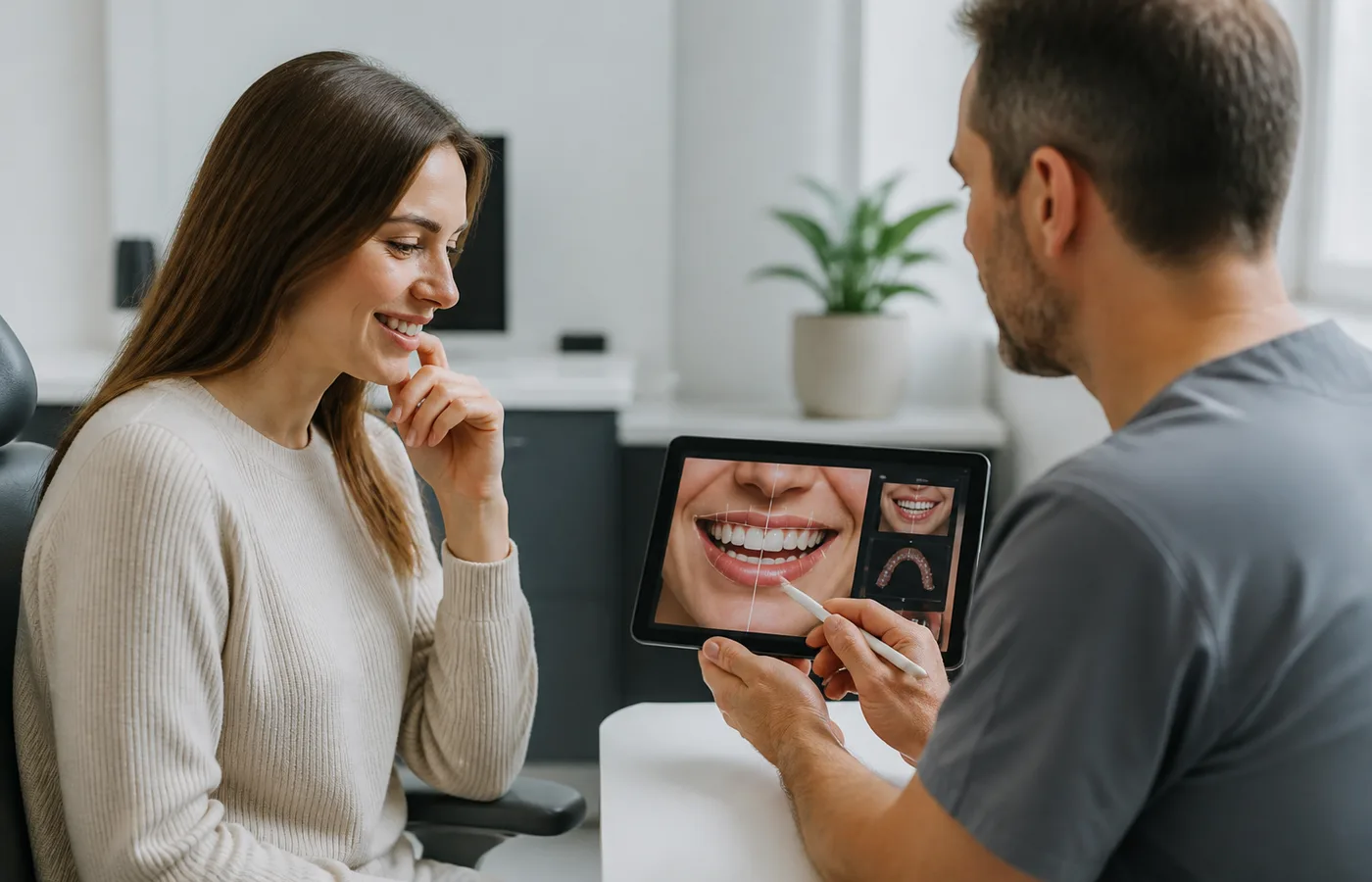
It cannot. Tooth dimensions, jaw structure, lip movement, gum level and how much of the teeth shows during a smile are individual. Transferring a result seen on someone else is therefore not a realistic starting point.
Building expectations from images is common, but planning rests on a person's own oral structure and clinical findings. This is why healthcare facilities discuss expectations in detail at the first meeting; whether a particular expectation can be met is something that can only be assessed after an examination.
One of the most common sources of confusion while researching is that different applications are used interchangeably. Whitening concerns the colour of a tooth and does not aim to change its shape or position. Composite adjustments address small differences in shape using material shaped directly on the tooth. Laminate veneers and crown type restorations, by contrast, are pieces of work directed at the surface or the whole of a tooth and may involve a laboratory stage.
Orthodontic guidance is a separate heading again; it concerns the position of the teeth and usually requires a longer timeline. Adjustments relating to gum level are likewise assessed on their own terms. The practical consequence of these distinctions is that two people describing the same expectation may be directed towards different headings. Only an examination reveals which heading corresponds to your findings.
Where a tooth is missing, planning around the smile is usually considered together with the question of how that gap will be handled. The heading that deals with the root side of a missing tooth is a separate treatment area with its own assessment criteria; you can read about it in full on our dental implants page.
Restorations applied over teeth that are still present do not replace a missing tooth on their own. Whether the two headings are addressed together, in sequence, or not at all is part of the clinical decision.
No. This depends entirely on the application selected and on the current state of the teeth. Some restoration types may require a certain amount of preparation of the tooth surface, while colour-related work or composite adjustments are handled within a different scope. Which preparation is needed, how much tissue preparation would be involved and whether alternatives exist can only be explained by the qualified dentist after an examination. No such prediction can be shared on this page.
The overall timeline does not depend on a single factor. The following can shorten or extend it:
For this reason no fixed number of days or dates is given here. A timeline becomes clear only after an individual assessment, and it is set by the healthcare facility involved.
Depending on the scope of a plan, the process may fit into a single visit or spread across more than one. Where an orthodontic stage or laboratory processes are involved, the number of visits and the intervals between them may change. That decision belongs to the medical side, and the travel calendar is built around it.
This is where LumiVita works on aligning calendars with one another: matching flight dates with appointments, airport transfers, lodging arrangements, language support during meetings and keeping communication going between visits. You can read about how the wider process works on our health tourism page.
How the work behaves over the years is associated with more than one factor. Oral hygiene habits, the course of gum health, clenching or grinding habits, diet and the nature of the beverages consumed, smoking, and whether review appointments are kept are the headings that stand out.
How colour-related work behaves over time also varies between individuals and habits; no dental application can come with an open-ended durability commitment. Maintenance, whether a need for renewal will arise and how follow-up should be arranged are matters only the treating dentist can address for your situation.
What every plan shares is that the outcome is bounded by a person's own anatomy. Possible risks of the applications, situations such as temporary sensitivity, adjustments that require fine-tuning and the differences between options are topics discussed during an examination. Only the qualified dentist who examines you can explain what these mean in your case. General articles on related subjects are available on our blog page.
What you share when you begin talking about the process helps the healthcare facility clarify what it will need from you. If you already hold radiographs or reports, passing them on, together with your treatment history, the medication you take and any known diagnoses, prevents correspondence from dragging out unnecessarily.
Describing your expectation in your own words matters as well; saying whether your interest lies in colour, in shape or in the alignment of the teeth sharpens the focus of the conversation. Whether what you have shared is sufficient, and whether further imaging is needed, is nevertheless decided by the healthcare facility involved. LumiVita does not assess, interpret or turn this information into a plan; it only keeps the exchange moving in an orderly way.
LumiVita does not examine, diagnose, prepare treatment plans, select physicians or make commitments about outcomes. Its remit is the organisational side: establishing first contact, passing on information shared by the healthcare facility, aligning appointment and travel calendars, airport transfers, lodging arrangements, language support during communication, keeping organisational communication going throughout the stay, and continuing that communication after you return home.
If you would like to start a conversation about the process, you can reach us through the free preliminary assessment form. Sharing information does not substitute for a decision on suitability.
People who ask about smile design usually describe situations such as these:
Which of these pictures can be associated with which application is determined by the qualified dentist after an examination, any imaging considered necessary and an assessment of oral health. None of the situations listed amounts to suitability on its own, and the same plan is not built for everyone.
The points people highlight while researching the process are usually the following:
These points do not apply equally to everyone. Which approach suits a person depends on the outcome of the clinical assessment, and results vary from person to person. This content does not offer any prediction about outcomes.
The general flow differs between healthcare facilities, but it mostly includes these steps:
The order, number and spacing of the steps vary between individuals. All clinical decisions rest with the qualified dentist; LumiVita deals only with appointment, travel and communication organisation.
Depending on the type of work carried out, the early period may involve temporary sensitivity, tenderness around the gums or a period of adapting to new surfaces. How this unfolds varies with the person and the plan. Following the healthcare facility's guidance on diet, oral hygiene and use of the restorations is the most decisive element of this stage.
Over the longer term, the condition of restorations and of colour-related work is associated with brushing and interdental cleaning routines, gum health, clenching habits and keeping review appointments. Whether a need for renewal or adjustment arises is assessed by the treating dentist.
Recovery time and post-treatment recommendations may vary depending on your personal health condition and the method applied. Specific guidance is shared after a doctor's evaluation.
LumiVita does not make medical decisions; information comes from healthcare institutions and the process may vary by person.
Your application is received securely and reviewed for process coordination.
Transfer and accommodation steps are coordinated according to your preferences.
Communication support is provided during your stay in Türkiye.
Communication support continues after your return.
Treatment suitability and medical decisions are determined by authorised healthcare professionals.
We have gathered the questions asked most often about smile design. The answers are general information; only a qualified dentist can provide an individual assessment.
No. There is no single treatment that carries the name smile design; the term describes a planning approach in which the teeth, gums, lip movement and facial proportions are assessed together. What is eventually carried out is a combination of applications that differs from person to person. Two people can therefore end up with plans that share almost nothing: for one only colour-related work may be discussed, while for another guidance on alignment comes to the foreground. The qualified dentist who examines you decides the scope of the plan in light of clinical findings.
Colour-related work such as whitening, shape adjustments made with composite materials, thin bonded restorations described as laminate veneers, crown and coverage type restorations, orthodontic guidance concerning alignment, and adjustments relating to gum level can all be discussed here. Where a tooth is missing, implant assessment comes up as a separate treatment heading. A long list does not mean everything is applied together; most plans contain only one or a few of these. The selection rests with the qualified dentist after an examination, not with the person researching options.
It cannot. Tooth dimensions, jaw structure, lip movement, gum level and how much of the teeth shows during a smile are individual. Transferring a result seen on someone else is therefore not a realistic expectation. Building expectations from images is common, but planning rests on a person's own oral structure and clinical findings. This is why healthcare facilities discuss expectations in detail at the first meeting; whether a particular expectation can be met is assessed only after an examination, and results vary from one person to another.
No. Whether the tooth surface is prepared depends on the application selected and on the current condition of the teeth. Some restoration types may require a certain amount of preparation, while colour-related work or composite adjustments fall within a different scope. Which preparation is needed, how much tissue preparation would be involved and whether alternatives exist can only be explained by the qualified dentist after an examination and any imaging considered necessary. This content cannot share such a prediction and is not a substitute for an examination.
The overall timeline does not depend on a single factor. The scope of the plan and the number of teeth involved, whether preparatory work inside the mouth is needed, whether orthodontic guidance enters the plan, the sequence of laboratory stages, trial stages and any adjustments considered necessary, and the frequency of review appointments can all shorten or extend it. For this reason no fixed number of days or dates is shared here. The timeline is clarified by the healthcare facility after an individual assessment, and travel planning follows it.
Untreated decay, gum inflammation, advanced gum disease, root canal related problems or fractured older restorations are usually placed ahead of everything else in a plan. The reasoning is straightforward: restorations placed on a healthy foundation allow a plan that can be followed over time. Gum health also shapes the visible outcome, because the level and texture of the gum tissue are connected to how a smile is perceived. The scope of this preparatory stage differs between individuals and can directly affect the overall timeline.
How the work behaves over the years is associated with more than one factor. Oral hygiene habits, the course of gum health, clenching or grinding habits, diet and the nature of the beverages consumed, smoking, and whether review appointments are kept are the headings that stand out. How colour-related work behaves over time also varies between individuals; no dental application can come with an open-ended durability commitment. Only the treating dentist can share a prediction specific to your situation, and that requires examination and follow-up.
Depending on the scope of the plan, the process may fit into a single visit or spread across several; where an orthodontic stage or laboratory processes are involved, the number of visits and the intervals between them may change. That decision belongs to the medical side. LumiVita works on matching flight dates with appointments, airport transfers, lodging arrangements, language support during meetings, organisational communication throughout the stay, and keeping in touch after you return home. None of the clinical decisions are made by LumiVita.
Share your key details and the LumiVita team will contact you about process, travel and organisation steps.